
Why Your Table Saw Kicks Back: The 4 Real Triggers (Not Just "Be Careful")
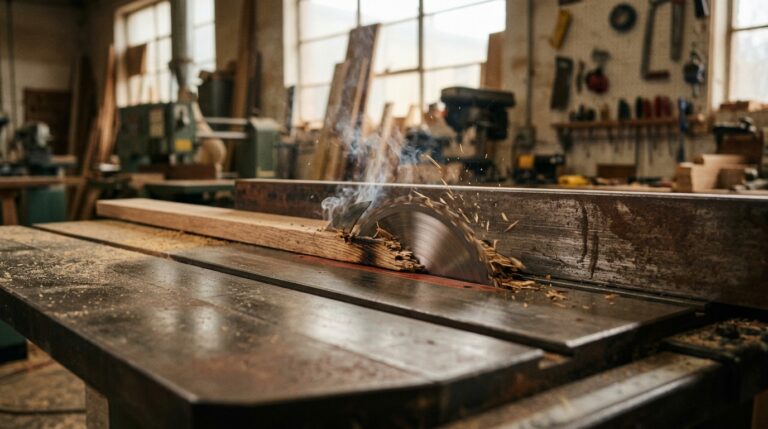
Quick answer: Table saw kickback has exactly four mechanical causes, and every documented kickback traces back to one of them: (1) the fence isn’t parallel to the blade, so it squeezes the workpiece into the blade’s back edge; (2) the kerf pinches shut on the blade — from a trapped offcut, a missing riving knife, or wood that isn’t lying flat; (3) the workpiece physically rises or rotates into the back of the blade, where the teeth are moving upward; (4) internal stress in the wood releases mid-cut and the two halves move on their own. All four end the same way: the wood contacts the rising teeth at the back of the blade and gets thrown backward, toward the operator, in well under a second.
“Be careful” doesn’t prevent any of that, because none of it is about carelessness. It’s about geometry, wood movement, and where a spinning tooth happens to make contact.
Why “be careful” was never the real answer
Every table saw safety guide includes a version of “pay attention” and “don’t stand behind the blade.” That advice isn’t wrong, but it treats kickback like an unpredictable event you have to stay alert for, instead of a mechanical failure with an identifiable cause. According to OSHA’s definition (drawn from the UL 987 safety standard), kickback is specifically the sudden reaction to a workpiece that’s pinched, bound, or misaligned relative to the blade — not a random malfunction. If you can name which of those three conditions is present before you make the cut, you’ve already prevented it. That’s the actual value of understanding the mechanism instead of just the warning.
The physics: why kickback is faster than you can react
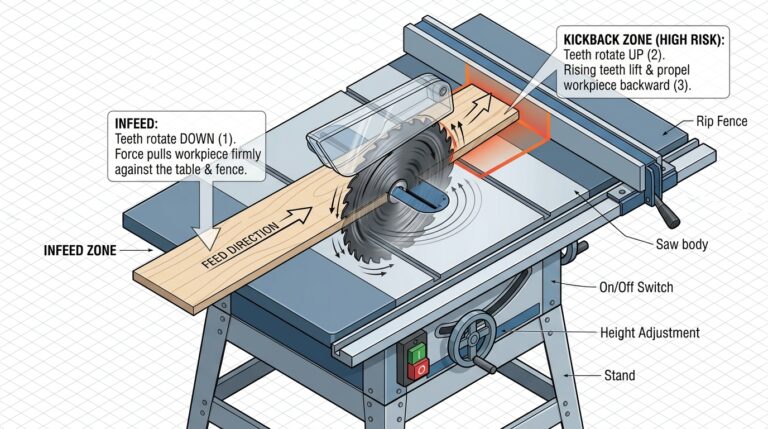
A table saw blade is designed so that at the front of its arc — where you feed the wood in — the teeth move downward, pressing the workpiece flat against the table. That’s what makes a normal cut feel stable. But at the back of the blade, past the point where the wood exits, the teeth are moving upward. If the workpiece ever makes contact with that rising back edge, the blade doesn’t cut it — it catches it, lifts it, and throws it.
Here’s roughly how fast that edge is moving. A common 10-inch blade spinning at 4,000 RPM has a rim circumference of about 31.4 inches. Multiply that by the rotation speed and you get a tip speed of roughly 10,470 feet per minute — about 119 mph. Independent safety-engineering sources put real-world kickback tooth speeds in the same range, generally cited as exceeding 100 mph and in some cases over 120 mph. At that speed, a kickback event is finished — wood airborne, already past you — in well under a second, faster than a person can consciously react. That’s not a scare tactic; it’s the reason every prevention method below is about stopping the contact before it happens, not reacting once it starts.
It’s also why kickback shows up so heavily in the injury data. CPSC figures reported by NPR put table saw injuries at roughly 30,000 requiring medical treatment each year in the U.S., with about 4,000 resulting in amputation — and kickback-driven blade contact is a recurring factor across that data, not an outlier event.
The 4 real triggers
1. Table saw fence alignment and kickback: the toe-in problem
The rip fence has to be exactly parallel to the blade, for the blade’s entire length. If it isn’t — specifically if the back of the fence angles in even slightly toward the blade, a condition called toe-in — the workpiece gets squeezed as it travels past. That squeeze pushes the wood sideways into the blade, and because it’s happening near the back of the blade, it’s pushing the wood directly into the rising teeth.
Toe-out (fence angled slightly away from the blade at the back) is far safer than toe-in, and many saw manufacturers actually recommend a hair of toe-out as a margin of error. Check this with a dial indicator against the miter slot, not by eye — a misalignment small enough to be invisible is still large enough to cause this.
2. Pinching: when the kerf closes on the blade
As the blade cuts, it leaves a kerf — the slot behind it — that needs to stay open. Pinching happens when that kerf closes on the blade instead: a riving knife or splitter isn’t installed, the cutoff piece drifts and gets trapped between the blade and the fence, or the board simply isn’t sitting flat so the kerf doesn’t open evenly. Once the blade is pinched from both sides, it grabs rather than cuts, and the rotational force transfers into the workpiece.
This is the specific failure a riving knife exists to prevent. A table saw riving knife is a thin plate mounted directly behind the blade that physically holds the kerf open as the wood passes, so the two halves of the cut can’t close back onto the spinning teeth. It’s different from an older-style splitter, which is usually fixed to the saw’s trunnion and doesn’t rise and fall with the blade the way a riving knife does — which matters if you change blade height often. Riving knives weren’t standard on all new table saws until UL’s design requirement phased in between 2008 and 2014, so if you’re running an older saw, check whether yours has one at all.
3. Feeding into the back of the blade
This is the direct version of the contact described in the physics section above: the workpiece itself rises or rotates into the rising rear teeth, rather than being squeezed into them by the fence or a pinch point. It happens a few ways — cupped, bowed, or twisted stock that doesn’t lie flat and lifts slightly as it’s pushed through; a freehand cut with no fence or miter gauge, where the trailing end of the board is free to rotate into the blade; or removing the blade guard and riving knife for a cut and forgetting the kerf now has nothing keeping it open. Anti-kickback pawls — the spring-loaded fingers on many guard assemblies — are a secondary backstop for this specific failure, not a substitute for it: they can catch a board that’s already started moving backward, but they don’t prevent the initial contact.
4. Wood tension release
This is the cause that has nothing to do with your setup. Every board carries internal stress from how the tree grew and how the lumber dried, and ripping a board releases that stress unevenly — the two halves can bow, twist, or spring toward each other mid-cut, closing the kerf even on a saw with a riving knife and a perfectly aligned fence. You can’t fully predict which boards will do this from looking at them, though reaction wood, boards with visible internal checking, and wood that’s still acclimating to your shop’s humidity are the most common offenders. A riving knife still helps here — it can’t stop the wood from moving, but it limits how far the kerf can close before the knife itself holds it open.
What kickback has actually taught me
I’ve had exactly three moments in fifteen-plus years where a cut started to bind, and looking back, each one maps to a different cause above.
The first was a fence that had drifted out of parallel after I loosened and re-tightened it for a dado cut — classic toe-in, and I only found it afterward with a dial indicator. The second was ripping a piece of construction-grade pine that had clearly been under stress in the stack — the kerf closed visibly behind the blade the second I was past the halfway point, tension release, no setup error involved at all. The third was a cutoff piece I didn’t realize had drifted toward the blade until it caught — a pinch point I created by not paying attention to where the offcut was heading, not by any flaw in the saw.
None of the three ended in an injury, and the reason is almost certainly that in all three cases I wasn’t standing directly behind the blade — a habit that costs nothing and, per OSHA’s own guidance, is one of the single most effective things you can do, because it takes you out of the line of travel entirely.
How to prevent table saw kickback: a 4-point checklist
| Cause | What to check | How often |
|---|---|---|
| Fence-blade misalignment | Dial-indicator check for toe-in along the full fence length | Any time you loosen/re-clamp the fence rail, and monthly otherwise |
| Pinching | Riving knife or splitter installed and sized to the blade in use; offcut has somewhere to go, not trapped against the fence | Every cut where you’re removing a narrow offcut |
| Feeding into the back of the blade | Stock lies flat with no cup/bow/twist; fence or miter gauge used, not freehand; guard and riving knife reinstalled after any cut that required removing them | Before every cut with questionable stock |
| Wood tension release | Rip suspect boards (visible reaction wood, checking, uneven grain) with extra caution and a sharp blade at a slower feed rate | As needed, based on the board |
(If you haven’t checked your fence-to-blade alignment recently, that’s cause #1 above, and it’s the fastest of the four to fix. My free Dead-Square Every Time Tune-Up Checklist walks through the dial-indicator check in about 15 minutes.)
What to do if a cut starts to bind
If you feel a cut starting to bind or hear the pitch of the motor change under load, the response is the same regardless of which of the four causes is at play: stop feeding, turn off the saw, and wait for the blade to come to a complete stop before you touch the workpiece. OSHA’s own case files include an incident where an operator used his hand instead of a push stick to free a binding workpiece and suffered a serious hand injury as a result — the saw was still coasting. A blade that looks like it’s slowing down is not a blade that’s safe to reach toward.
Standing to the side of the blade rather than directly behind it, for every cut, is what keeps a kickback event from becoming a kickback injury even when one of the four causes above does occur.
Table Saw Kickback Causes FAQ
Why does my table saw kick back? Kickback happens when the workpiece contacts the rising teeth at the back of the blade — caused by a misaligned fence, a pinched kerf, the workpiece rising or rotating into the blade, or internal wood stress releasing mid-cut. It’s a mechanical event with an identifiable cause, not random bad luck.
Does a riving knife prevent all kickback? No, but it prevents the most common cause: the kerf closing and pinching the blade. It doesn’t prevent kickback from a misaligned fence, from feeding a twisted board freehand, or fully from tension release, though it does limit how far the kerf can close in that last case.
Is it safe to remove the blade guard for better visibility? It’s legal on a saw you own for personal use, but it removes a layer of protection without addressing any of the four causes above — and if the riving knife is attached to the guard assembly on your saw, removing one may remove the other.
Where should I stand when ripping on a table saw? To the side of the blade’s line of travel, not directly behind it. If kickback occurs, the workpiece travels backward along that line — standing to the side takes you out of its path entirely.
How fast does a kicked-back board actually travel? It depends on the wood’s mass and how much contact the rising teeth got, but the blade’s own tip speed is a reasonable ceiling — commonly over 100 mph on a standard 10-inch blade, which is why the whole event happens faster than a person can react.
The short version
Kickback has exactly four causes, and all four are things you can check for before you ever start the cut: is the fence parallel to the blade, is the kerf going to stay open, is the workpiece going to stay flat and controlled, and is this a board likely to move on its own once you cut into it. Naming which one applies to the cut in front of you is the entire skill — everything else is just the checklist above.
For blade selection issues that compound some of this (a dull or wrong-tooth-count blade increases binding risk on its own), see our table saw blade guide. For a full saw alignment walkthrough, see the table saw setup guide.