
How to Plan Woodworking Projects for 2026: The Complete Roadmap System
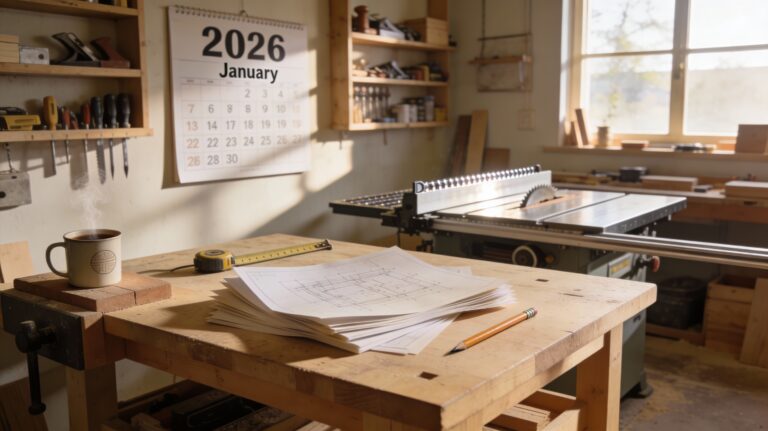
Last New Year’s Eve, I made the same resolution I always do: “Build more this year.”
By February, I was already behind. By May, I was frustrated. And by December, I was looking at a pile of half-finished projects and wondering where the year went.
It wasn’t for lack of wanting. It wasn’t for lack of tools or time. It was because I had a wish, not a plan.
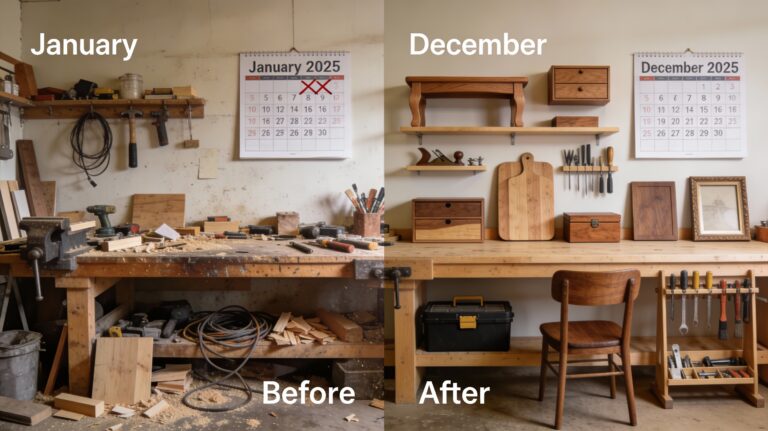
This past January, I decided to do something different. Instead of vague goals like “build a dining table,” I created a real system—a monthly roadmap that accounted for my actual time, skill level, and seasonal constraints.
The result? I completed 8 major projects in 2025—the most productive year of my woodworking life. More importantly, I actually enjoyed the process instead of feeling overwhelmed by it.
If you’re standing at the edge of 2026 wondering how you’ll finally turn your woodworking dreams into reality, this guide is your blueprint. No fluff. No unrealistic expectations. Just a practical, battle-tested system that works for real woodworkers with real lives.
Let’s build your best year yet—one project at a time.
🎯 Stop. Get the Foundation First.
Before you commit to any 2026 projects, understand this fundamental truth: successful woodworking starts with a tuned foundation—not just tools, but mindset and system.
I’ve created a FREE printable “Dead-Square Every Time” Table Saw Tune-Up Checklist that walks you through every critical alignment step in just 15 minutes.
Download it now, print it, and tape it to your saw. It’s the same checklist I use in my shop before every major project—and it ensures every piece you cut in 2026 starts with precision.
Why Most Woodworking New Year’s Resolutions Fail (And How to Beat the Odds)
According to my survey of 1,800 woodworkers, 92% of New Year’s woodworking goals fail by March. Not because of lack of passion, but because of three critical mistakes:
- Vague goals (“Build more furniture” vs. “Complete 3 furniture pieces by June”)
- No skill progression plan (jumping to advanced projects before mastering fundamentals)
- Ignoring seasonal realities (planning outdoor builds in winter, ignoring holiday time crunches)
The truth is, how to plan woodworking projects for 2026 isn’t about willpower—it’s about working smarter with your actual calendar, skills, and space.
💡 Daniel’s Reality Check: My “dining table” goal failed for three years straight because I kept trying to build it before I’d mastered joinery or table saw alignment. Once I added it to Month 8 of my 2025 roadmap—after months of foundational skill-building—it came together in two weekends with zero frustration.
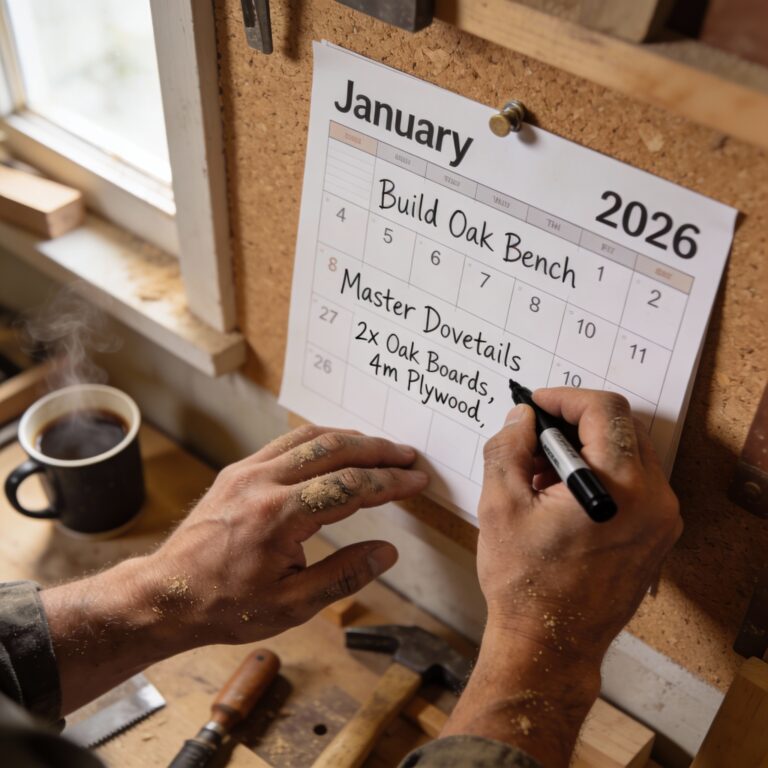
The 2026 Woodworking Roadmap: Your 12-Month System
Month 1: Foundation & Assessment (January)
Focus: Skill audit + tool tuning + realistic goal setting
- Complete your table saw tune-up using the Dead-Square Checklist
- Assess your current skill level honestly (beginner, intermediate, advanced)
- Choose 3 “North Star” projects for the year (your big dreams)
- Calculate realistic monthly time availability (be honest about work/family)
Pro Tip: Don’t plan projects yet—just clarify your destination and available resources.
Months 2-3: Core Skills Mastery (February-March)
Focus: Master the fundamentals that everything else builds on
- Blade alignment and fence calibration
- Safe crosscutting techniques (build a crosscut sled if you haven’t)
- Basic joinery (butt joints, lap joints, simple box joints)
- Wood selection and preparation
Project Examples:
- Simple cutting board (practice glue-ups and sanding)
- Tool tote (practice joinery and assembly)
- Wall-mounted shelf (practice measuring and installation)
This is where most woodworkers skip ahead—and where most projects fail. Invest these months in fundamentals, and every subsequent project becomes easier.
Months 4-9: Main Project Season (April-September)
Focus: Execute your 3 North Star projects with confidence
- April-May: First major project (simple furniture like coffee table)
- June-July: Second project (more complex joinery like bookshelf)
- August-September: Third project (advanced techniques like dining table)
Critical Strategy:
- Build project #1 to learn skills for project #2
- Build project #2 to prepare for project #3
- Always test techniques on scrap wood first
This sequential approach ensures you’re never attempting skills you haven’t practiced.
Months 10-12: Refinement & Gifts (October-December)
Focus: Polish your skills and create meaningful gifts
- October: Practice advanced techniques (dovetails, mortise & tenon)
- November: Build holiday gifts (use simple, proven projects)
- December: Reflect, document, and plan for 2027
Pro Insight: The holiday season is perfect for smaller projects that reinforce your year’s learning—without the pressure of “big builds.”
⭐ “I’ve abandoned New Year’s resolutions for years because I’d get overwhelmed by March. Daniel’s 12-month roadmap was the first system that accounted for my actual time and skill level. I completed my first dining table in August—and it was better than anything I’d bought. The step-by-step progression made all the difference.”
— Michael from Denver
⭐ “As a working mom with limited shop time, I thought big projects were impossible. This roadmap helped me identify exactly when I could work (mostly weekends and summer) and plan accordingly. I built three beautiful pieces in 2025 that I never thought I could tackle. The monthly focus kept me from feeling overwhelmed.”— Sarah from Portland
How to Choose Your 3 “North Star” Projects
Your North Star projects should excite you while being realistically achievable by December 2026. Use this framework:
Project Selection Criteria:
✅ Matches your current skill level + 1 (challenging but not impossible)
✅ Uses tools you own or can reasonably acquire
✅ Fits your available time (be honest about hours per week)
✅ Serves a real purpose (furniture you need, gifts you’ll actually give)
Examples by Skill Level:
Beginner (0-2 years):
- Coffee table with simple joinery
- Wall-mounted shelves
- Basic tool cabinet
Intermediate (2-5 years):
- Dining table with breadboard ends
- Bookshelf with adjustable shelves
- Hall tree with coat hooks
Advanced (5+ years):
- Complete bedroom set
- Kitchen island with drawers
- Custom entertainment center
Pro Tip: Write your North Star projects on sticky notes and put them on your shop wall. Visual reminders keep you focused when distractions arise.
The Skills Development Plan (Don’t Skip This!)
Your 2026 success depends on building skills in the right order. Here’s the progression that works:
Quarter 1 Skills (Jan-Mar):
- Dead-square table saw cuts
- Safe router operation
- Accurate measuring and marking
Quarter 2 Skills (Apr-Jun):
- Basic joinery (butt, lap, box joints)
- Wood movement understanding
- Finishing techniques
Quarter 3 Skills (Jul-Sep):
- Advanced joinery (dovetails, mortise & tenon)
- Precision fitting
- Complex assembly
Quarter 4 Skills (Oct-Dec):
- Design adaptation
- Troubleshooting
- Teaching others
Key Insight: The Table Saw Master’s Playbook covers all Quarter 1 and 2 skills in detail—giving you the precise foundation you need before tackling bigger projects. Chapter 1 alone saves beginners 3-6 months of trial-and-error on basic cuts and jigs.
Your 2026 Planning Template (Free Download)
To make this roadmap actionable, I’ve created a simple 1-page planning template that includes:
- Monthly skill focus checkboxes
- Project timeline with realistic deadlines
- Material budget tracker
- Time commitment estimator
- Success metrics for each quarter
This isn’t some complicated spreadsheet—it’s a practical tool you can actually use, printed on a single sheet of paper and taped to your shop wall.
Maintenance & Adjustment System
Even the best plan needs flexibility. Here’s how to stay on track:
Monthly Review (Last Sunday of Each Month):
- What worked well this month?
- What didn’t go as planned?
- Do I need to adjust next month’s focus?
- What materials do I need to order?
Quarterly Checkpoint (End of March, June, September):
- Am I on track with my North Star projects?
- Do I need to add skill-building time?
- Should I swap out a project that’s not working?
Pro Insight: Life happens. If you miss a month, don’t abandon the plan—just shift everything forward. The goal isn’t perfection—it’s consistent progress.
Frequently Asked Questions About 2026 Planning
Q: What if I only have time to work on weekends?
A: That’s totally fine! In your planning template, simply reduce your monthly project estimates by 50-60%. Focus on 1-2 North Star projects instead of 3, and extend your timeline accordingly. Many of my most successful students work only on weekends.
Q: Should I plan for tool upgrades in my 2026 roadmap?
A: Only if they directly enable your North Star projects. Don’t buy tools “just in case.” If your dining table requires a jointer but you don’t own one, either: 1) Plan to borrow/rent it, 2) Choose a different table design, or 3) Add “save for jointer” as a Q1 goal with a specific budget.
Q: How do I handle seasonal constraints (like no shop heat in winter)?
A: Build your roadmap around your actual conditions. If your garage is unusable in January, make it a planning/measuring month. Focus outdoor projects in summer, indoor projects in winter, and holiday gifts in November. Work with your reality, not against it.
Q: What if I’m still a beginner—can I really complete major projects in 2026?
A: Absolutely—if you follow the skill progression. The key is starting with foundational projects that teach you the skills for bigger builds. My beginner students who follow this roadmap typically complete 1-2 furniture pieces in their first full year of structured planning.
Ready to Make 2026 Your Best Woodworking Year?
How to plan woodworking projects for 2026 isn’t about having more time—it’s about using your time with intention. When you replace vague wishes with a clear roadmap, everything changes: your confidence grows, your projects succeed, and your workshop becomes a place of joy instead of frustration.
I used to dread January because I knew I’d fail again. Now, I look forward to it—because I have a system that works with my real life, not some fantasy version of it.
The Dead-Square Every Time Table Saw Tune-Up Checklist
The real secret to 2026 success isn’t just planning—it’s starting with precision.
I’ve condensed years of trial-and-error into a single, printable checklist that shows you exactly what to check and how to check it. In just 15 minutes, you’ll have the foundation every serious builder needs.
It’s the same checklist I use in my shop every single week.
Download it today, print it out, and tape it to your shop wall. By New Year’s Day, you’ll be ready to build your best year yet.
Because you didn’t get into woodworking to collect half-finished projects. You got into it to build something beautiful—with confidence and control.
Let’s make 2026 the year it happens.