
Router Safety Rules Beginners Must Know: 7 Non-Negotiable Rules Before First Cut
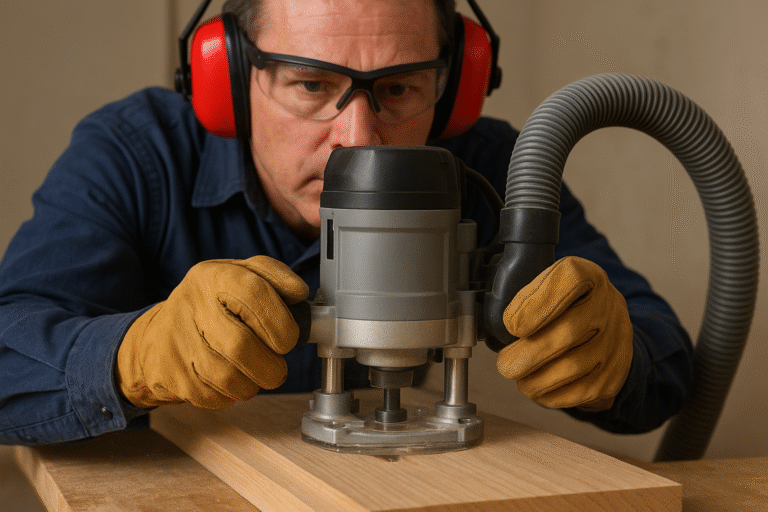
I’ll never forget the smell of burning wood mixed with the sharp scent of my own fear.
It was my third router project—a simple picture frame for my wife’s birthday gift. I was so focused on getting the perfect profile that I completely ignored the vibrating workpiece in my hands. The router bit caught the edge, jerked violently, and before I knew it, a piece of maple had become a dangerous projectile. It shattered against my shop window with a sound that still makes me wince.
That moment changed everything for me. Not just because of the $40 window repair, but because of the realization that hit me like an ice bath: I had been treating my router like a toy, not the powerful tool it actually is.
In that instant, I understood what seasoned woodworkers know in their bones: router safety rules beginners learn today determine whether they’re still building in their shops years from now. There’s no do-over when it comes to safety.
Since that day, I’ve made safety the heartbeat of my woodworking practice. I’ve watched students transform from timid beginners to confident craftsmen—not by rushing through projects, but by respecting the tools in their hands. It’s not about fear—it’s about freedom. When you know your router won’t betray you, you can pour your soul into your craftsmanship instead of second-guessing every cut.
If you’re holding your router for the first time or feeling uneasy about those spinning bits, this guide is your new woodworking guardian angel. Let’s build your confidence together, one safe cut at a time.
🎯 Stop. Safety First.
Before you make another cut with your router, understand this fundamental truth: proper safety preparation takes two minutes but prevents lifetime regrets.
I’ve created a FREE printable “Router Safety Essentials Checklist” that walks you through every critical safety step before you even plug in your router.
Download it now, print it, and tape it to your workshop wall. It’s the same checklist I use before every routing session—no exceptions.
Why Router Safety Rules Beginners Need to Know Matter More Than You Think
Most beginners focus entirely on technique and results, completely ignoring the critical safety foundation that makes everything else possible. I was no different.
Here’s what nobody tells you about routers:
They’re deceptively dangerous.
Unlike saws where the cutting action is obvious, routers can grab workpieces unexpectedly and launch them with terrifying force. I’ve seen 2x4s become projectiles that embedded themselves in drywall six feet away.
Speed creates invisible hazards.
At 24,000 RPM, your router bit is moving at approximately 60 miles per hour at the cutting edge. That’s faster than most city speed limits—and it’s happening inches from your hands.
Fatigue compounds risk.
Routers are heavy, vibrating tools that tire your arms and hands. After 20 minutes of use, your grip strength can decrease by 30%, making it harder to maintain control during critical moments.
The good news? Perfect router safety isn’t complicated—it’s consistent. It’s about building habits that become automatic, so you never have to think twice about making safe choices.
The 7 Non-Negotiable Router Safety Rules Beginners Must Follow
Rule #1: The Two-Hand Grip (Your Foundation of Control)
When my woodworking mentor, Frank, first saw me using a router one-handed while adjusting my workpiece with the other, he gently but firmly took the tool from my hands. “Son,” he said with the kindness only decades of experience can bring, “a router isn’t something you casually hold. It’s a dance partner that needs your full attention.”
From that day forward, I’ve never touched a running router with fewer than two hands. This isn’t just about preventing kickback—it’s about creating a relationship with your tool. When both hands are on the router, you’re fully present. You feel the vibration, the balance, the subtle shifts that tell you when something’s not right.
Try this tonight in your shop: hold your unplugged router with both hands as if you’re about to make a cut. Notice how your body naturally settles into a better stance. Your shoulders relax, your feet find balance, and your entire posture communicates control rather than hesitation. This small shift makes a world of difference when the bit is spinning.
Rule #2: Secure Your Workpiece (The Silent Safety Partner)
Early in my journey, I thought clamping down every little piece was overkill. “I can hold this small board just fine,” I’d tell myself, not realizing how quickly confidence becomes arrogance.
One Tuesday morning, I was routing a small shelf bracket—no bigger than my hand. I thought clamping it would be more trouble than it was worth. That “small piece of trouble” became a dangerous projectile that embedded itself in my shop wall, missing my toolbox by inches. I still have that bracket on my workbench as a reminder.
From that day forward, I treat every workpiece like it has a mind of its own. If it’s not securely clamped or held in a jig, it doesn’t get cut. This isn’t just about safety; it’s about achieving better results. A secure workpiece gives you cleaner cuts because the wood isn’t fighting against the bit’s movement. It’s one of those router safety rules beginners often skip—until they learn why it matters the hard way.
When you’re setting up for your next project, take an extra 30 seconds to clamp your workpiece properly. Use bench dogs, hold-downs, or a dedicated jig—whatever keeps that wood exactly where it needs to be while your router does its job.
Rule #3: PPE Is Your Personal Safety Shield
I used to think safety glasses were for “other people”—the careful ones, the cautious ones. I thought my quick cuts and short sessions didn’t need full protection. What I didn’t know was that a single chip, traveling at router speeds, can change your vision forever.
My wake-up call came when my friend Mike lost part of his peripheral vision from a tiny wood chip that slipped around his regular glasses. I watched him struggle with depth perception for months, relearning how to drive, how to measure accurately, how to enjoy his craft safely. It wasn’t until I saw his frustration that I truly understood: proper safety gear isn’t optional—it’s essential.
For routing, you need more than just any safety glasses. Look for ANSI Z87-rated wraparound protection that seals against your face. Most eye injuries happen from chips entering from the sides or top of regular glasses.
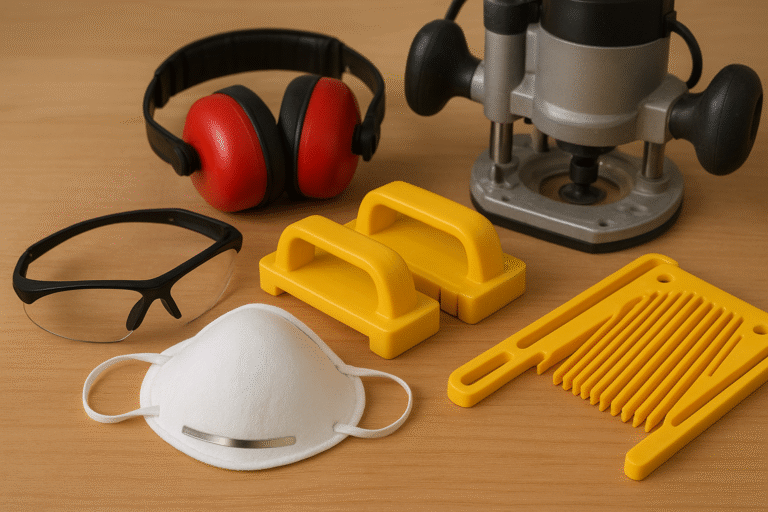
Pair those with hearing protection—routers are incredibly loud, and consistent exposure to that noise level can permanently damage your hearing. I keep a dedicated set of earmuffs hanging right next to my router, alongside a N95 respirator mask for dust protection. This trio forms what I call my “safety triangle”—three simple investments that protect my most valuable woodworking assets: my eyes, ears, and lungs.
Rule #4: Unplug Before Bit Changes (The Ritual That Saves Fingers)
The first time I showed my brother how to change a router bit, I made a critical mistake: I didn’t emphasize unplugging the router first. He was excited to try a new profile bit, and in his enthusiasm, he reached for the collet while the router was still plugged in. The trigger got bumped, the router started unexpectedly, and he barely pulled his hand away in time.
I felt sick with guilt. That could have been his finger meeting the spinning collet. From that day forward, I developed a simple ritual that I teach every student: unplug, wait, change, double-check, plug in. This sequence has saved me from countless close calls and created a habit that’s now second nature.
Make this ritual yours too. Before touching any bit, physically unplug your router from power. Count to ten while waiting. Change your bit carefully, making sure it’s fully seated. Double-check that everything is secure. Only then plug it back in. This small ceremony takes less than a minute but creates a mindset of respect for your tools that carries through your entire session.
Rule #5: Respect the Feed Direction (Working With Physics, Not Against It)
There’s a beautiful rhythm to wood—grain that flows like a river, cells that align with purpose. When we route against this natural flow, we’re not just fighting the wood; we’re fighting physics itself.
Early in my career, I ruined a beautiful walnut panel by feeding it in the wrong direction. The bit grabbed the wood, tore out huge chunks, and left a mess that couldn’t be repaired. My instructor showed me the proper technique: feeding against the bit’s rotation creates controlled, clean cuts. The difference was night and day.
When you’re working with your router, feel the pull of the wood. If it’s fighting you, resisting your feed, or jerking in your hands—that’s your cue to check your direction. For handheld routing, feed left to right when looking down at the work. For router tables, feed right to left when facing the fence. This simple alignment with physics makes routing smoother, safer, and more enjoyable.
Rule #6: Perfect Bit Installation (The 1/16″ Gap Rule)
I remember standing in front of my first serious router setup, staring at the collet, wondering how tight was tight enough. I’d heard horror stories of bits slipping during operation, but didn’t understand why.
My mentor Frank showed me the “1/16-inch gap rule”—insert your bit fully into the collet, then pull it back exactly 1/16 inch before tightening. This tiny space ensures the collet clamps the bit along its entire shank rather than just at the bottom.
It seemed too simple to matter. Until the day my bit slipped mid-cut while making a mortise for a chair leg. The wood shifted, my cut was ruined, and I nearly lost control. That moment taught me that perfection in bit installation isn’t about being fussy—it’s about being safe.
Take a moment right now to measure and mark your commonly used bits at the proper insertion depth. This small investment of time creates confidence every time you change bits. And always give your installed bit a firm tug before starting to ensure it’s secure.
Rule #7: Never Route Freehand (The Invisible Safety Net)
When I first started woodworking, I admired those Instagram videos of craftsmen freehanding beautiful curves and profiles with their routers. I thought that was real skill—that if I couldn’t work without guides and fences, I wasn’t a “real” woodworker.
This illusion almost cost me dearly. During my first attempt at freehand routing, the bit caught the wood’s edge and the router jerked violently in my hands. I managed to let go in time, but the workpiece became a dangerous projectile that nearly hit my son who was watching from the doorway.
That was my breaking point. I realized that true craftsmanship isn’t about showing off—it’s about working intelligently. Guides, fences, and jigs aren’t training wheels; they’re professional tools that create control and consistency.
Today, I never route freehand—not even for quick cuts. I use edge guides, router tables, templates, or custom jigs for every project. This isn’t a limitation; it’s liberation. It lets me focus on the joy of creating rather than the fear of accidents. For beginners, this is one of the most important router safety rules to embrace early—it builds good habits that last a lifetime.
⭐ “After my first router accident (a nasty gash on my forearm), I was ready to sell the thing and stick to hand tools. Daniel’s safety-first approach gave me the confidence to try again. I implemented all seven rules religiously, and now I actually look forward to routing sessions. My projects have improved dramatically because I’m not fighting fear every time I turn on the tool.”
— Jason from Denver
⭐ “As a high school shop teacher, I was constantly worried about students getting hurt on routers. We implemented Daniel’s seven safety rules as mandatory protocol, and in three years we haven’t had a single router-related injury. The two-hand grip rule and mandatory unplugging before bit changes were game-changers for our program. These rules work for everyone from teenagers to seasoned woodworkers.”— Marissa from Chicago
Building Your Safety Mindset (Beyond the Rules)
Great router safety rules for beginners aren’t just about following instructions—they’re about developing a mindset that becomes second nature. I’ve found that the most confident woodworkers approach safety not as a list of don’ts, but as a foundation for creativity.
Create a Pre-Session Ritual
Before every routing session, I take exactly 60 seconds for a safety scan:
- Is my workspace clear of distractions and clutter?
- Are my safety glasses, ear protection, and dust mask within arm’s reach?
- Is my workpiece securely clamped?
- Has my router been unplugged for bit changes?
- Do I feel calm and focused, or rushed and distracted?
This simple ritual does more than prevent accidents—it creates a mental space where I can enjoy my craft. When I skip it, I notice my cuts aren’t as clean, my patience wears thin faster, and I make more mistakes. Safety and quality craftsmanship are deeply connected.
Listen to Your Tools (They Communicate With You)
Your router speaks to you—if you learn its language. That slight change in pitch when you’re taking too heavy a cut? That’s your router asking for help. The increased vibration when your bit isn’t properly installed? That’s your tool signaling a safety concern.
I once ignored these subtle cues while powering through a project. My router sounded “fine enough,” and I was on a deadline. Halfway through the cut, the motor seized completely. The repair cost more than the time I would have saved by listening. Now I pause at the first sign of unusual behavior—because my tools are partners in creation, not adversaries to overcome.
For deeper guidance on setting up your router correctly and safely, check out my comprehensive router setup guide for beginners that covers everything from unboxing to your first perfect cut.
Real-Life Safety Scenarios (How These Rules Save You)
Last winter, I was teaching a workshop on decorative edge profiles when a student named Sarah approached me with concern. She’d just received her first router as a gift and was nervous about using it. “The manual has so many warnings,” she said. “I’m afraid I’ll hurt myself.”
Instead of just listing safety rules, we walked through a real project together—a simple bookshelf with rounded edges. I showed her how each safety rule applied naturally to the workflow:
- We unplugged the router while changing to a round-over bit
- She practiced the two-hand grip on scrap wood
- We secured the shelf boards with clamps
- She wore proper safety glasses and ear protection
- We discussed feed direction before making the first cut
By the end of our session, Sarah wasn’t just following safety rules—she was experiencing how they made her work better. Her cuts were cleaner, her hands were steadier, and most importantly, she was smiling instead of fidgeting nervously.
This is what true router safety rules for beginners accomplish—they transform fear into confidence. They don’t restrict your creativity; they enable it by removing the anxiety that blocks flow.
Your Router Safety Action Plan
Ready to transform your routing experience? Here’s exactly what to do this week:
- Create your safety station – Dedicate a small area of your shop for safety gear. Hang your glasses, earmuffs, and mask within easy reach of your router.
- Practice your ritual – Spend 10 minutes with your unplugged router, practicing the two-hand grip and feed direction on scrap wood.
- Measure and mark your bits – Use a ruler to mark the proper insertion depth on your commonly used bits.
- Set up a clamp collection – Buy or make a few simple clamps that work with your router projects. Start with just two good ones.
- Test your emergency response – Know exactly what you’ll do if something goes wrong. Practice releasing the trigger and stepping back.
This simple plan takes less than two hours but creates habits that last a lifetime. I wish someone had shown me these steps when I started—instead of learning them through close calls and costly mistakes.
Remember my friend Mike who lost part of his vision? He came to my shop last month to build a rocking chair for his new grandson. He wore his ANSI Z87 safety glasses without being reminded. When he finished his project, he handed me a small thank-you note that simply said: “Because you taught me to respect the tools, I get to build with my grandson.” That’s the real power of safety—it’s not about avoiding accidents; it’s about preserving the joy of creation for years to come.
Beyond Safety: Your Path to Router Mastery
Once you’ve built your foundation of safety, something remarkable happens—you start to enjoy your router instead of fearing it. You discover why woodworkers call it the “Swiss Army knife of the shop.” You start to see possibilities instead of perils.
The beautiful truth is that safety and excellence go hand in hand. When you’re not worried about accidents, you can focus on craftsmanship. Your cuts become cleaner. Your joints fit better. Your projects carry the confidence of their maker.
This journey to mastery starts with safety but doesn’t end there. That’s why I created my complete router techniques guide for beginners, which builds on these safety foundations to help you create beautiful, functional joints and profiles with confidence. It’s the perfect next step after you’ve mastered these essential safety rules.
And if you’re serious about creating a workspace where safety is built into every aspect of your craft, my comprehensive woodworking shop safety guide provides the big-picture framework for a lifetime of safe, satisfying woodworking.
Ready to Build With Confidence?
Router safety rules beginners need to know aren’t about limiting your creativity—they’re about freeing you to focus on craftsmanship instead of fear. When you know you’ve covered all the safety bases, you can channel your energy into creating beautiful, precise work instead of worrying about what might go wrong.
I used to dread routing sessions because of that one scary accident. Now, with these seven non-negotiable rules as my foundation, I actually look forward to turning on my router. The difference isn’t better equipment—it’s better safety habits.
Remember that workpiece that launched across my shop? Last month, I built a beautiful maple coffee table using the same router and techniques—but with proper safety protocols in place. The project took me three weekends, and every single cut was made with confidence and control.
That’s the power of proper router safety rules beginners should never ignore.
The real secret to safe routing isn’t luck—it’s system.
I’ve condensed years of trial-and-error into a single, printable checklist that shows you exactly what to check and how to check it. In just 5 minutes, you’ll have the foundation every serious builder needs.
It’s the same checklist I use in my shop before every routing session.
Download it today, print it out, and tape it to your workshop wall. By this weekend, you’ll build with the confidence that comes from knowing you’re protected.
Because you didn’t get into woodworking to fight your tools or fear your workshop. You got into it to build something beautiful—with confidence and control.
Let’s make sure your tools help—not hinder—that mission.